Thursday, 15 September 2016

Task 2.1 - Phases of the Music Video

Q1: What camera angles, shots, movement & position, are still used today from the ‘Hard Day’s Night’ Performance music videos?


In the performance music video for ‘If I Fell’ from Richard Lester’s ‘Hard Day’s Night’ a lot of different camera shots and angles are used. All of them that can be identified in the video are still used today; this is because Richard Lester established the codes and conventions for the production of a performance music video. For example, there is a high angle shot of the band very early on which clearly shows the viewer the band in it’s entirety and is used in most performance music videos today. As well as this, there are close ups of instruments being played (Ringo playing the drums). Finally, there’s a distinct use of handheld camera from the viewpoint of where the crowd would be, almost making it a POV shot. Most people dreamt of watching the Beatles from front row seats and this video gives them the best representation of what it would be like.


Q2: Discuss what the appeal was of MTV in the 1980s and analyse it in relation to Thriller/Video killed the radio star.


The appeal of MTV in the 80s can be defined from two points of view, the audience and the producers. The producers loved MTV because it was a TV station that ran 24/7, constantly broadcasting music videos. This meant that if they made a music video and it was broadcast on MTV it would increase the number of people that received their product thus getting them more profit and the artist more publicity. The audience would like MTV as it would allow them to view the most popular music videos whenever they wanted, thus letting them connect further with their favourite artists. MTV made music videos extremely successful and this was highlighted by The Buggles’ song ‘Video killed the radio star’. As well as this, Michael Jackson’s ‘Thriller’ was extremely successful due to how intense it’s video was. It was just as, if not more, scary than most horrors at the time and it was paired with what was probably his most popular song. You could argue that this would not be the case if the video had not been received so well.            

Q3: Discuss what elements of the Marilyn Monroe musical scene are borrowed by Madonna? Think in terms of the similarities of Mise en Scene: location, setting, costumes, props, body language etc.


In Madonna’s ‘Material Girl’ video she has very cleverly decided to copy, almost exactly, the props, costumes, location and body language that Marilyn Monroe is surrounded by in ‘Diamonds Are a Girl’s Best Friend’ video from the film Gentlemen prefer blondes. She has done this due to the success of Marilyn, as well as the fact she is commonly deemed as the most attractive women in the world. This may be because she desires to achieve that or to simply pay homage to such a definitive piece.


Saturday, 10 September 2016

Creative Journey - Entry 1

In this entry to my creative journey I will cover my research and planning into previous music videos.

In class we looked at two music videos, Bad Romance by Lady Gaga and Formation by Beyonce. T analyse these video correctly, as they were deemed as rich texts, we looked into semiotics (study of signs) and Ferdinand De Saussure. Doing this further research allowed me to gain wider knowledge on media theories as well expand my ability to analyse a media text.

In Bad Romance I uncovered the message behind the song, about how Lady Gaga felt she had been treated by the industry. The video depicts a form of prostitution and this represents how Gaga feels the industry works.

Beyonce's Formation is a call to action regarding the civil rights movement currently taking the US by storm, Black Lives Matter. She does this through referencing Malcolm X and certain scenes aimed to highlight police brutality.

Monday, 5 September 2016

Task 2.1 - Lady Gaga - Bad Romance - Semiotic Analysis

The beginning of the video features a forward tracking shot of all the actors involved in the music video. It shows clear binary oppositions between the genders (females in white, males in black) according to the theory by Levi Strauss. It also portrays a very powerful image of the music industry which is the main motif of the production. It reveals the extremely sexualised images desired by the industry for both genders, but also shows how every artist is similar through the pretty much identical costumes that everyone is wearing.

There's also significant amounts of product placement during the very same scene. There is an mp3 player and three bottles of 'Lex' vodka. This is to highlight the amount of product placement within music videos due to the capitalist nature of the industry trying to milk as much money through such tactics as well as things like celebrity endorsements. One of the more profound examples being 'Beats' headphones which are endorsed by Dr. Dre.


The crucifix and 'god ray' are two of the more subtle semiotics within the video and are biblical references. The god ray is represents the idolisation and worship of today's more popular artists and celebrities with the most idolised one being Kim Kardashian. People worship celebrities like gods because of their fame. The crucifix is placed upon Lady Gaga's capsule and I perceive it to have been placed there for two reasons. Either because she is also worshipped in a godlike fashion and her coming out of the capsule is like resurrection of Christ but also because maybe only God can help restore her morality and innocence which has been stripped away by the industry in which she is a slave too.

Possibly one of the more striking scenes is the revelation of Lady Gaga and her monsters as they climb out of their capsules. They come out dressed in all white and this bares significance away from the binary oppositions aforementioned. The whiteness represents how they enter the industry as blank slates that are innocent but malleable to what is demanded of them to become successful 'artists'.


To further expand on my most recent point, there's a compelling scene which features two females corrupting Lady Gaga by forcing her to drink the Lex vodka. The two women start off by ripping away her clothes leaving her exposed wearing just her undergarments, this is a metaphor for the industry taking away her innocence. After this, they are then seen towering over her, intimidating her. This is a potential reference to some of the tactics used within the industry to control artists. Then they finally complete the process of corruption by pouring the drink down her throat whilst she struggles. Following this Lady Gaga is then seen surrounded by people who we can presume are her fans/other artists 'attacking' her as they rip off her jacket revealing a much more sexualised individual. This pans out revealing her to be surrounded by men watching her and all the others. This represents the industry looking for 'talent'. Lady Gaga and the other 'artists' begin doing an identical dance routine, this looks innocent but is actually telling the viewer how the industry only wants the same type of artist over and over again but looks for someone who is especially good at it. This confirms my point I previously made about the industries capitalist ideologies wanting to use cash cows for personal gain.


Another significant point to be made out of this scene is how it is women forcing her to do these things rather than men. This is due to the fact that women in the modern era complicit more to sexualising themselves and each other more than it is forced upon them by the males they so often blame. The women 'attacking' her could also be a metaphor for the competitive nature between women in the industry constantly battling each other commonly with vicious tactics and slanderous comments that isn't as prevalent withing the male side.


There is also a distinct number of feline references within the video including a shot of her back showing a very feline-like spine, a sexually provocative crawl that is also linked to the way cats stalk their prey and the more obvious one, a cat. These metaphors represent Lady Gaga herself as big cats are renown to be ferocious and very high up in the food chain, as well as this, all types of cat are very unwilling to be domesticated. We know for a fact that Lady Gaga is also unwilling to be domesticated through her outrageous articles of clothing such as a dress made out of meat and her general image as an artist being different to everyone else's so she is perceived as 'weird'.


The music industry is dominated by male led business and this is represented through the 'auction' that is portrayed. The men watching Lady Gaga represent said industry and they begin bidding on her, only taking interest in her now she is what they want precisely. This way of looking at it reveals how bad the industry is in modern times and what corrupt practices it gets up too.

Towards the end of the video we see Lady Gaga walking away from the camera wearing a cape made out of a dead polar bear with its head still attached. The message this conveys is an extremely dark view on modern society. It shows us how we deem it acceptable for people to do things like that because they're rich and famous but also how a lot of people in that position see nothing wrong with it as they also believe they are superior to normal people. Furthermore, it conveys the riches that can be achieved from conforming to the industries demands, almost justifying the industries actions due to the possible rewards.

Shortly after, we see the remainder of the scene. Except she has took the cape off and is standing in her underwear in front of the winning 'bidder', however, she sets him on fire. This is imagery for her conquering the industry and not relying upon them to be successful anymore. All while the polar bears head is in the foreground linking back to my previous comment about her being top of the food chain. The video then ends with her lying on the burnt bed with the corpse next to her whilst in underwear launching fireworks from her bra. This is Lady Gaga telling the industry that she doesn't need them anymore, that she has won and is celebrating it. It also confirms to the viewer that she can now act the way she pleases as an artist in her songs and music videos due to her now being popular. 


To conclude, the video can also be seen as a giant metaphor for Lady Gaga's experience of the industry and what she's had to do to achieve fame and succeed otherwise she wouldn't be in the same position that she is in today.

https://en.wikipedia.org/wiki/Bad_Romance

http://vigilantcitizen.com/musicbusiness/lady-gagas-bad-romance-the-occult-meaning/

Friday, 19 August 2016

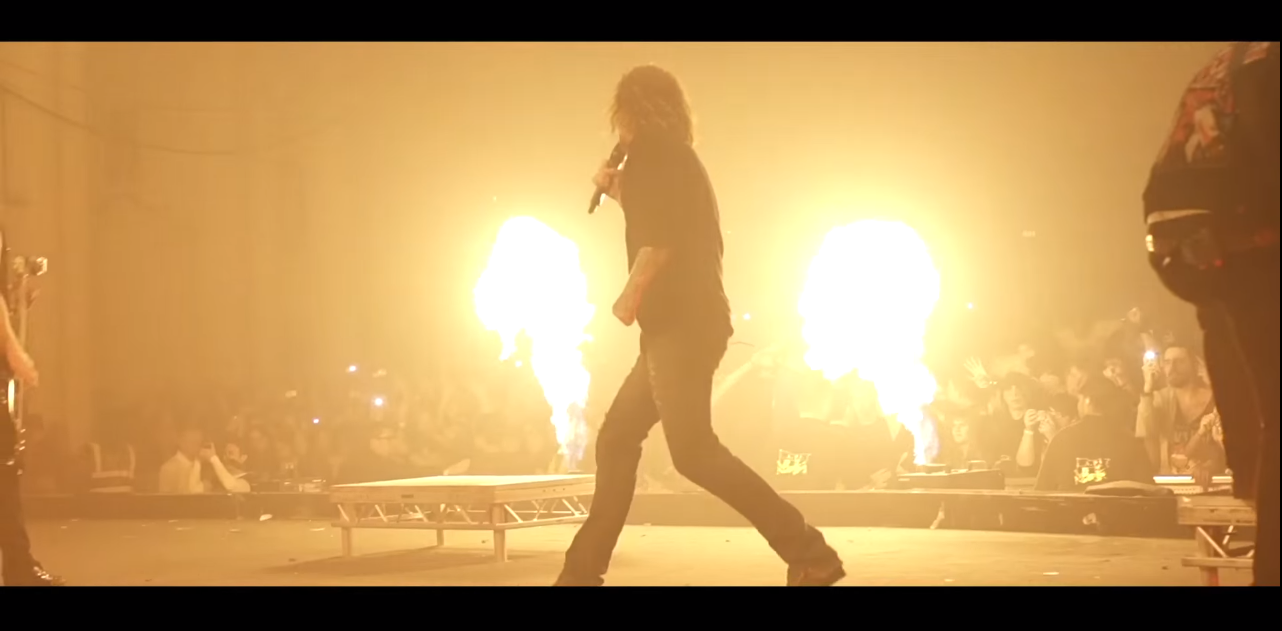
Task 2.1 - Asking Alexandria - Run Free [Music Video Analysis]

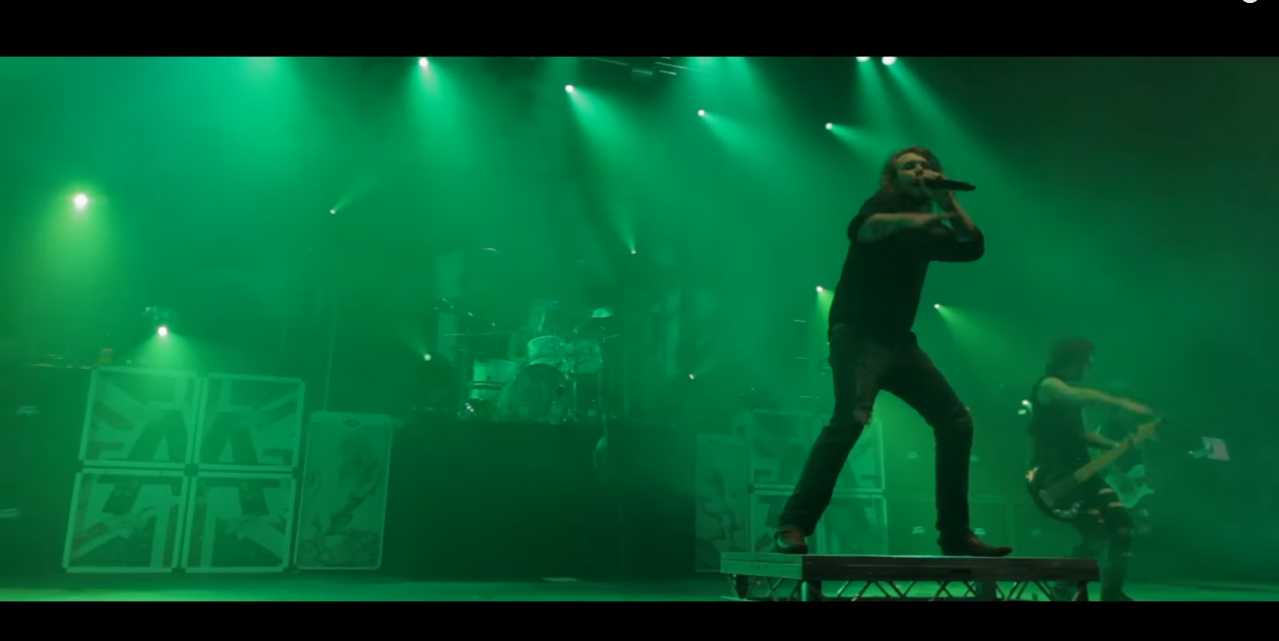
Straight from the beginning of this music video it is clear to see that it is a 'performance' music video, this is shown to us through the first shot showing the entire band and an audience in front of them. This is one of the conventions established by Richard Lester originally used in the music video for 'If I Fell' in 'Hard Day's Night'.
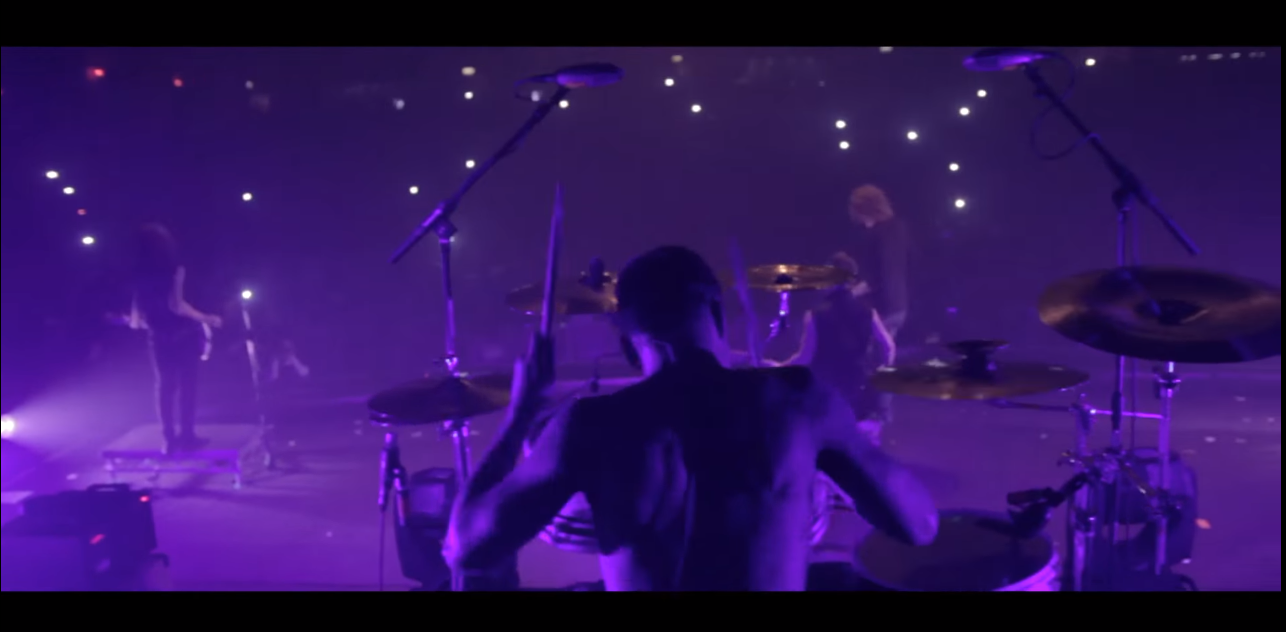
The following shot is handheld. This is for multiple reasons, it is to give a sense of action as the song picks up in tempo and volume but it is also to give a feeling that you're there. Like you're behind the drummer watching his every move. As well as this, the angle of this shot coming from behind the drummer at the very back of the stage is intended to give the viewer a feeling of awe. It is almost as if the viewer is on the stage being watched along with the band.

The use of cranes is predominant within this music video, tracking downward each time. This gives a sense of scale to the music video and shows that it was in fact filmed at a show live and not in a studio. It brings the video to life as you can see almost everyone at the show coming to life whilst the band play.
This is another handheld Point-Of-View shot but from the audiences perspective. It is there to make you feel like a member of the crowd but also shows how the band are idolised by the positioning of the camera. It is also a low angle shot and pictures the band members towering above the audience and is a fairly accurate representation as if they weren't idolised then people wouldn't turn up to their concerts.

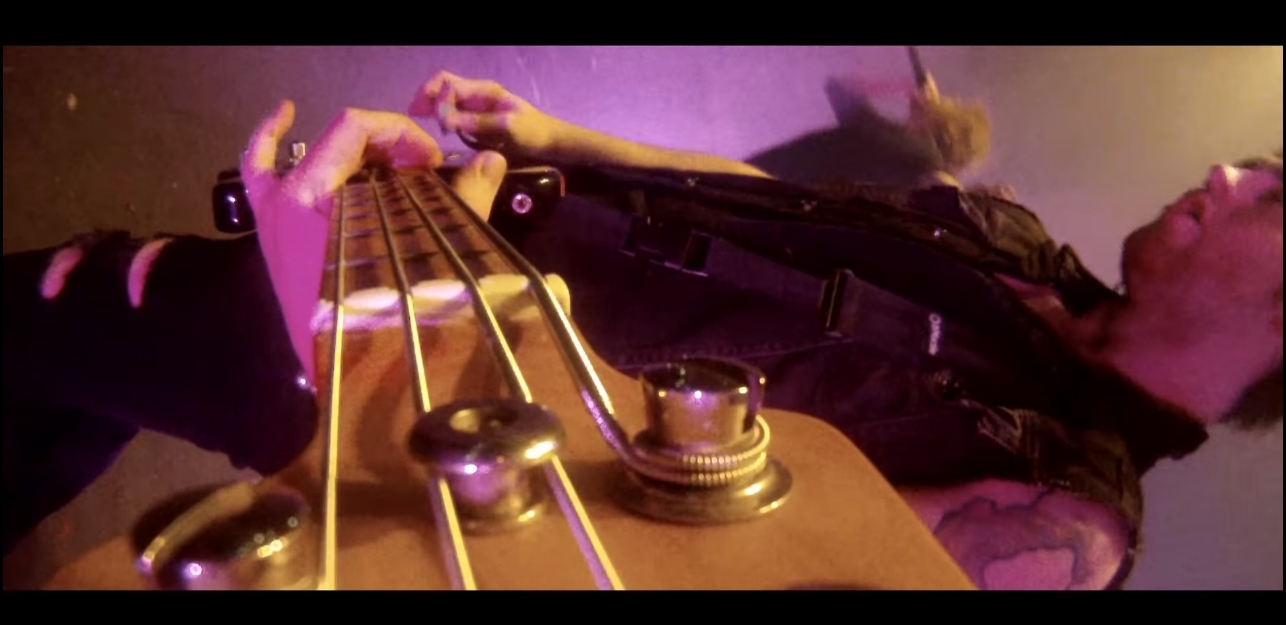
Another example of a convention established by Richard Lester is a close-up of instruments being played. In this music video it is done in a way that is very unusual. It was achieved by attaching a GoPro Camera to the head of the guitar facing down the neck. This shows the guitarists playing at an angle never seen before and is somewhat an evolution of the convention originally set by Richard Lester.

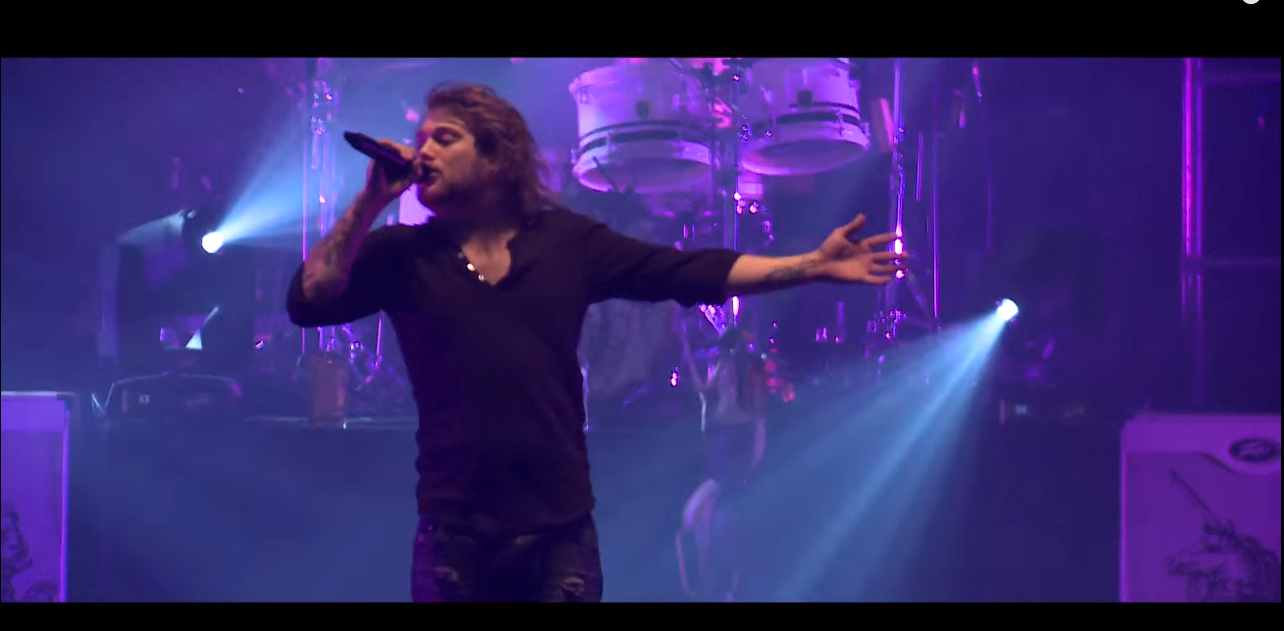
This medium shot allows the audience to establish who the main vocalist is as no one else is in shot except him at that precise moment in time. As well as that, he is in the foreground of the shot with drums in the background, once more reinforcing that he is the main member due to his positioning on the stage.
Slow motion is used throughout the music video accompanied with shots from behind the band once more delivering a sense of awe. Slow motion is not a convention from Richard Lester but derives more from it's use in the film industry to convey an immense feeling of action taking place which is further represented through the tempo of the music at that point in time. 

A High Angle shot is also used as the member of the band use the GoPros on the ends of their guitars to bring the audience into view, showing the venue completely lit up by mobile phone torches and lighters. Yet again bringing about the common theme of this music video, awe. 


The music video ends like it started, with an establishing/long shot of the band standing on the stage as the music fades out and the screen fades to black signalling the end of the 'performance'. 

Task 2.1 - Comparing Andrea Arnold’s ‘Wasp’ and Lynne Ramsay’s ‘Gasman’


A short film is usually a low budget, indie film that drops the audience straight into the thick of the narrative. It usually doesn’t come full circle, often ending on a cliff-hanger of sorts, as with a small run time it is hard to create a fully developed narrative. Short films are usually created so people can show off their creativity and skills which then allows them to be ‘spotted’ by bigger companies who will later fund them in developing full feature films.

In Wasp, there is a neglectful mother who is metaphorically the wasp. She constantly puts her children in danger for her own gain by doing things such as leaving them outside a pub all night so she can have a drink with a man she met earlier that day after coming back from fighting one of her neighbours… This is reckless behaviour with no sense of caring for those who she should love the most making a wasp a fitting metaphor. The wasp is a fitting metaphor because most people just see them as there to hurt you as they do not offer any benefits to anyone but themselves.

The children are exposed to drunk people and are forced to eat left over food from off the floor. Whilst eating, a wasp flies into the baby’s mouth causing the children to scream and panic. This causes the mother to pull away from kissing her male counterpart and rush to the kids where she does nothing but say ‘don’t sting him’. This once more shows her lack of care, as their mother she should be not put them in potential danger in the first place. This scene could show however, how she doesn’t intend for them to get hurt and she is just trapped in this life, like the wasp trying to get out the window earlier on in the film.

This representation of single mothers and Britain is completely inaccurate in my opinion, it makes it seem that every single mother from that part of the country openly endorses this type of behaviour. It also shows that this is what happens when women do not fulfil their stereotypical housewife role which everyone knows for a fact, is not the case almost 100% of the time.

The use of the children singing popular songs from the 90s, despite the severity of the situation, is contradictive but also represents the innocence of the children to not know any better as they have no reason to seem upset as it is just a regular day to them.

The camerawork is also ‘frustrating’, but in a positive way as it adds to the distress of the audience through the over use of handheld camera and the stylistic effects used make the camera appear old and grainy to reinforce the themes of poverty that drive the narrative of the film. The film is naturalistic and seems unscripted, almost like a documentary. The reason this is done is so that we feel as if we are watching it all unfold, but it also makes it impossible to help even though we want to because it feels so real.

Gasman is set in Glasgow in the 1970s, straight away we can see how life was hard as one of the children was playing with sugar, linking both films with a theme of poverty. In Wasp the children are dirty and underfed. They are also wearing dirty clothes that don’t necessarily fit them very well, this is due to their mother being on her own. In Gasman, it is essentially the same situation but the children appear to have better clothing which can be put down to the fact that they have a father on the scene, they aren’t necessarily fed better but they are dressed better.


There is a difference in camerawork as Gasman uses static cinematic shots such as a tilt up the railway tracks to bring the father and his children into the shot compared to the jittery handheld camera in Wasp. As well as this, Lynne Ramsay likes to use shots such as extreme close ups to convey meaning such as when the man’s other (ex)partner. The man takes two children off of her and they immediately mingle with the other children there which shows that the children have no worries despite the fact that the life they live is full of struggles, just like in Wasp.


Also like in Wasp, the father takes the children to what appears to be a Christmas party so he can drink with his friends. Whilst at the party however, the children find out that they both have different mothers but the same father which causes the two girls to turn on each other and begin to ‘fight’. As this gets revealed it soon cuts to them walking back in the dark down the railway, the lack of light stays for the rest of the film as it represents the depressing truth that the children have found out. Both films make us of natural lighting, turning darker towards the end, to convey meaning. The reduction of light also coincides with the storyline as develops in a negative direction.

Much like Wasp, Gasman is not accurate in terms of representation as it shows men as being unfaithful and wanting to sleep around even though the majority of men would stay faithful to their partner. Both films represent Britain as being dystopian and a bad place to live which in reality, is not the truth. Both directors differ in style but effectively portray a similar message, Andrea Arnold likes to use distressing, fast paced, handheld shots but Lynne Ramsay likes to use long lasting shots, that keep the target on screen for a large amount of time to convey meaning.


Thursday, 7 July 2016

Task 2.1 - Behind bars in San Quentin - Louis Theroux Documentary


‘Behind Bars in San Quentin’ is an actuality documentary by Louis Theroux informing the viewer what life is like inside the maximum security prison, San Quentin. Louis Theroux is the ‘Talking Head’ of the documentary and is in 90% of the shots.
The camerawork is primarily handheld to give the viewer a sense of realism, this is further enhanced by the use of handheld pans rather than static shot reverse shots during interviews with the inmates. It is easier for the cameraman to move should they need to as well as it allowing the viewer to feel like they’re actually standing between them, reminding the viewer they’re in of the most dangerous prisons on the planet.
At the very beginning of the documentary, it fades in from black and we see an extreme long shot of San Quentin to set the mood for the rest of the documentary as it informs the viewer of the dangerous situation they’re being taken into as well as to instantly portray that this documentary has been filmed professionally. As Louis enters one of the prison’s most dangerous areas, extremely upbeat, contrapuntal music begins to play. This is too separate the viewer from the reality of everything somewhat as it is a horrible place to be but also because this scene needs to use this style of music as anchorage for the BBC logo which appears, confirming that the viewer can expect a high quality documentary.
Whilst inside this ‘ward’ of the prison, the ambient sound levels have been raised slightly to surround them in violent banging and shouting, to link back to the general theme that flows throughout as aforementioned (extreme danger). However, the ambience levels are still low enough for a clear voice over to be heard stating facts and figures for the audience to keep in mind for the remaining duration of the documentary, a common convention of documentaries.
The editing is relatively basic with it being a documentary rather than a film. The main bit of editing is the opening titles which are still very simplistic but convey a clear message that links to the name of the documentary through the images used. Apart from this only basic fades, transitions and cuts are used to convey the passage of time or because they’ve changed location.
There is only natural light throughout the documentary which often results in very dark rooms with only a small glow in them. This is extremely effective as it is in fact the reality of the situation, the only light a lot of the people in the documentary see is natural. The camera crew do not bring artificial lighting equipment with them for that reason, to add effect, and because it isn’t logical to have such a large amount of equipment with them when they’re in such a vulnerable situation.
The prisoners are dressed in traditional jumpsuits, often with handcuffs on making them rather intimidating to the viewer despite them being restrained. As well as this, the guards carry weapons loaded with live ammunition which brings around a sense of realisation for the viewer that this is real and those people are dangerous. Despite this though, the body language of the guards and inmates juxtaposes this due to how ‘friendly’ they are with each other.
In conclusion, Behind Bars in San Quentin is an effective actuality documentary that informs the viewer about life in San Quentin.

Task 2.1 - Codes and Conventions of a Documentary


A documentary film is a nonfictional motion picture intended to document some aspect of reality. The opening needs to ‘hook’ the audience as quickly as possible. The central question of the documentary has to be posed at the beginning. Use quick snippets of interviews to draw the audience in. Incidental music or a soundtrack should accompany the opening sequence but not override the voice over. The title of documentary should burst onto the screen dramatically within 1-2 mins.


Different types of Documentary

Graphics – Documentaries often use graphics with written text. Maps, drawings and still photographs can be incorporated into the opening sequence. (i.e. Displaying interviewees name on a banner at the bottom with their profession).


Actuality - Filming real events as they happen. Can prove difficult (I.e. filming hurricanes and war).


Fly-on-the-wall – When you film real people as they do real things focusing on their lives.


Voice Over – A narration of what the programme is about. Interviews – Having an expert interview with someone who has ample knowledge of your topic and can give a clear insight into issues is vitally important.


Vox Pops - Speaking to ordinary people with a random interview (Such as EU interviews).


Talking head - A shot of someone to talking directly to the camera as a presenter of the documentary (i.e. David Attenborough).


Music – Critical for the opening sequence, needs to be balance well. Anchorage – linking titles or logos to music.

Website used for research - http://www.slideshare.net/crosswaysfederation/codes-and-conventions-of-documentary